Is Your “Self Care” Actually a Form of Avoidance in Disguise?

Parents need to take care of themselves in order to be ready to tackle the next challenge that comes along – which is constantly. How do we even begin to get a moment to ourselves? Most commonly it’s through stolen moments of screen-scrolling, and that is shown to actually drain our capacities, not increase them (Mostafavi, 2016).

Often our smartphone use is really a form of avoidance, and in the long run, avoidance is so stressful. I noticed that for me, the cycle becomes doing what I can get away with in the moment – because I finally have a moment – and my life is so hard that I deserve a moment for myself to do what I want! That’s okay, but it’s important to be mindful about the choices we’re making about how to these moments. If we choose something that just makes time pass, they cause zip toward the next hard thing, especially if I have been using electronics to avoid the hard things for most of the day.

Woman pauses laundry on sofa, distracted by her phone.
Photo by Karolina Grabowska on Pexels.com

I read an inspirational quote today. It said “Self-care isn’t about hot chocolate and bubble baths, it’s about having a life you don’t feel like you need to escape from” (Siddique, 2020).

Make life easier by facing the tough stuff!

Productivity and purpose make people happier. But how do we do it? One paradox of productivity is that we must be willing to have some things NOT get done in order to have the most essential things get done. If you’re disorganized, chances are you sometimes feel like prioritizing feels irresponsible. It is about choosing which things you will NOT do. It’s somehow satisfying to get to the end of your day and say, “At least I tried to do it all. Nobody could say I didn’t try!” …. But we have no business trying to do it all! Our business is to figure out only a couple things and learn to own the fact that the things which didn’t get done were ignored intentionally because you didn’t make a conscious effort to focus on them.

But don’t stick to ONLY tough stuff!

Here’s a pro tip: let’s not go too black and white on our thinking here. Don’t plan to only focus on the boring, horrible things or you will give up planning as a lifestyle and go back to being a victim of circumstance! This is where self-care comes in. Can we be real about what we can fit into a day? Can we be sure we have at least one item on our calendar (or option list) that brings a lot of personal satisfaction? It might be organizing one corner of your desk, or chatting on the phone with a friend, or maybe turning on some music and dancing like a fool. My sister feels she has received self-care when she’s had time to do her makeup and look her best. What minor upgrade are you craving today? Let it be something that leaves you feeling better than when you started. That way you’ll have MORE juice for giving to those kiddos, not less.

Mom and daughter ice a bundt cake.
Photo by Any Lane on Pexels.com

We can really find freedom from needing to find freedom by doing the work it takes to create the life that we truly want.

Mostafavi, B., (2016). Plugged in parenting: How parental smartphone use may affect kids. University of Michigan. https://www.michiganmedicine.org/health-lab/plugged-parenting-how-parental-smartphone-use-may-affect-kids

Siddique, H. (2020). Self-care is often a very unbeautiful thing. Embolden Psychology. https://embolden.world/self-care-is-often-a-very-unbeautiful-thing/#:~:text=True%20self%2Dcare%20is%20not,the%20eye%20and%20re%2Dstrategizing.

Tech for Tweens

So, your child has a device and you’ve discovered something you were hoping you’d never see. Or maybe you just heard about the scary things that are out there! Now what?

Step 1 – Don’t panic. The human brain’s natural reaction to stressful news is known as fight or flight – get mad or get scared. Both of those are reactions that flood your brain with cortisol. You can’t fully access the benefits of your cerebral cortex when you’re angry or afraid (Pederson, 2018). Ever notice that when you are in emotional overload is when you tend to make bad choices?

Photo by Sebastiaan Stam on Pexels.com

Step 2 – Don’t ignore it. Your brain wants to protect you from overload AND prevent conflict/danger/difficulty, so stay mindful. Don’t let your brain’s natural programming retreat to somewhere comfortable. Often, something seems awful right BEFORE you actually jump in and take it on. Don’t ignore the problem under any guise. Don’t tell yourselfΒ “I just respect their privacy” unless it’s truly a minor offense that’s better off being ignored than confronted. Check yourself, are you fearful? Then do what you need to do to get ready to take it on.

Step 3 – Get informed (and get support) here are some links to good advice on specifics for how to help your child manage their device. The information is constantly updating, so here I will refer you to some of my favorite resources for the latest research:

Step 4 – Be honest (you might need to practice your words first) Have a conversation. If you are dreading the conversation, get a mediator by your side (and another by theirs, if that helps). Clarify why it is you are stepping in. Give enough information necessary to inform them, but not to frighten them. This is a moment for vulnerability, not condemnation or demanding uncontested control.

Photo by Kindel Media on Pexels.com

Step 5 – Show love & empathy. Keep developing the relationship. Commit to continuing to learn about parenting – be open to learning new concepts and techniques that help you understand them and show empathy. Use discipline as a guide, not a weapon. You can’t protect them from everything, but that shouldn’t stop you from trying! Open the channels of communication and try to comprehend. How well you listen to them will have an enormous influence on how well they’ll listen to you. Listening and understanding do not automatically equate to agreeing or condoning. We can be understanding about how hard it is even as we’re insisting it has to be that way. Sometimes love means being willing to feel some of someone else’s pain.

Step 6 – Plan together what you will do next. Show them the decision you’ve made for screen-monitoring, blocking or filtering options based on your current research (make sure you’re aware which operating system your child’s device uses), then let them help you form the plan for when, what, and for how long. Plan in advance to be open to their input (make an informed decision, not an emotional one), but it’s easier to start strict and lighten up than it is to bear down after they’re accustomed to having a free-for-all. This is like using guard rails on the highway or baby proofing around the house – it may seem restrictive, but it’s for their protection. Let them know you’ll continue to adapt as they grow, but in addition to monitoring they need screen-free time to be able to develop social skills and impulse control (Grover, 2017).

Step 7 – Project Confidence. Kathy Koch, PhD, author of “Screens and Teens” (2015), advocates the idea that we are in the business of motivating our kids to internalize values that lead to good choices. She says we are not as effective when we are merely monitoring their choices and inflicting consequences when we see an error. Top-down, authoritarian parenting encourages rebellion, secrecy and feelings of shame. Fearful, passive parenting also doesn’t help our children develop in healthy ways, it’s a way to excuse ourselves from the unpleasantries involved in parenting. If we shouldn’t be dominant but we shouldn’t be passive, then what else is there? Confident, assertive, and empathetic parents. Set reasonable and firm boundaries, parent proactively to help increase the odds of success.

Photo by Monstera Production on Pexels.com

Step 8 – Follow up. When something happens outside the plan, and it inevitably will, don’t take it personally, but do take a stand. A passive parent who allows their child make all choices or protects them from the consequence of their choices is acting out of fear – fear of loss of their love. A dominant parent who refuses to be flexible with their child is also parenting out of fear – fear of loss of control. “Parenting should be neither passive nor aggressive, but assertive. You are the leader, but you are a wise, caring leader” Lawrence, 2010).

References:

Grover, S. (2017). “How technology lowers emotional intelligence in kids”, Psychology Today. https://www.psychologytoday.com/us/blog/when-kids-call-the-shots/201707/how-technology-lowers-emotional-intelligence-in-kids

Koch, K. (2015). Screens and teens: Connecting with our kids in a wireless world. Moody Publishers.

Lawrence, L. (2010). “Courageous Parenting”, October General Conference, Church of Jesus Christ of Latter Day Saints. https://www.churchofjesuschrist.org/study/general-conference/2010/10/courageous-parenting?lang=eng

Pedersen, T. (2018). “Why anxious minds can’t think right”, PsychCentral. https://psychcentral.com/news/2018/09/25/why-anxious-minds-cant-think-right#3

How I’m Helping My Kids Stay on Track for Homeschool During Quarantine

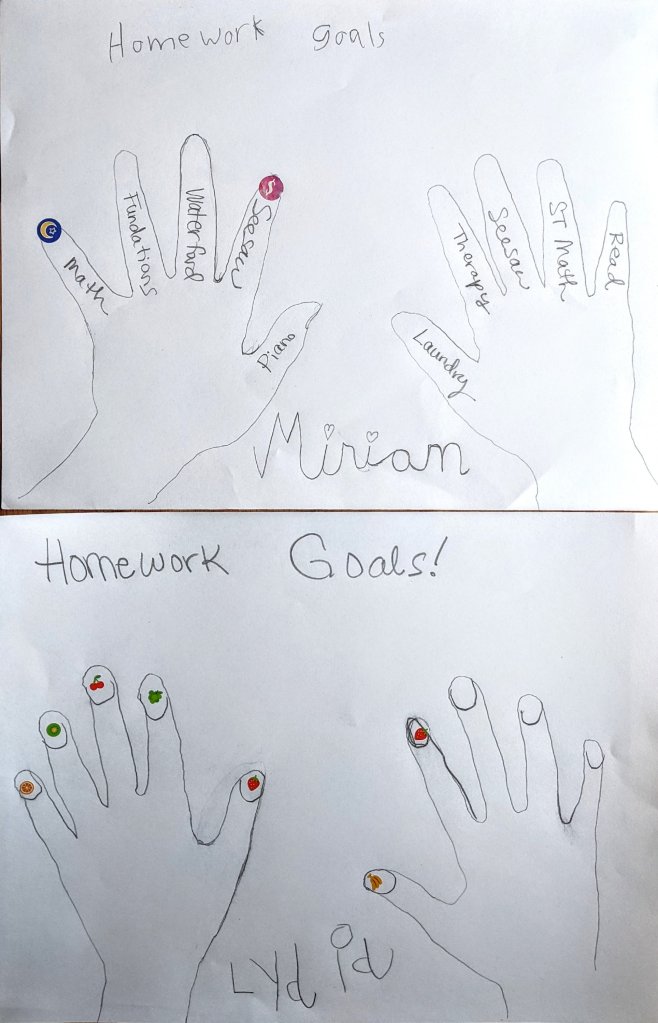
This is a picture of what I’m doing today to keep my youngest girls to stay on task with their school work. It matters to me that they’re motivated, rather than forced (otherwise it’s miserable for all of us!!) This has been the best strategy so far:

You don’t have to be an artist to create these simple hand-drawn charts to help track & visualize tasks for kids who are homeschooling.

You don’t need any special print-off; just trace their hands on a paper and write which actions earn them a sticker to put on each nail – or just use crayons if you don’t have stickers. Be as vague or specific as you need to be. Just keep it fun! The girls’ tasks here are divided into things like worksheet pages, 15 minutes at a time on math, reading a short book, as well as simple chores changing into their day clothes or clearing off their place at the table.

Ten is still a pretty big goal number, so I gave my littlest a bonus prize when she earned 5 stickers for the first hand, and the girls will each earn a manicure from Mommy once they’ve adorned all 10 fingers!

Traditional weekly fill-in-the blank charts were doing nothing for us, because they proved to be too abstract for a 5 and 7 year old. Then again, I can never expect that a chart will “do something” for me. Strategies fail quickly when they aren’t backed up by effort. Reminder charts have to be referred back to frequently so they get a chance to remind us to do the work. Having a visual strategy with short-term goal setting did really enhance their efforts, and the girls were happily referring back to these charts on their own!

This system is better than what we were doing before, because it visually displays how they’re progressing overall, rather than waiting all day for any benefits as they go through the mental list (usually I would just end up enduring the push-pull cycle!) This is also preferable to receiving little rewards for EACH step in the right direction, because they’re still getting some delayed gratification.

My kids’ school allows them to be self-paced, which has its own challenges, but I imagine visualizing a “countdown” could also be useful for those children who seem to have endless Zoom meetings.

I have a bonus tip which I’ve shared with some of my other young clients who have to endure back-to-back zoom meetings: Make tally marks as you listen to lectures. Use two categories, labeled “Stuff I already know” and “Stuff I didn’t know before” (or “New” and “Review”). This simple system gives your brain something to scan for, and scanning requires a lot less effort (and therefore requires less motivation) compared to the expected task of active listening. Think of scanning like when you’re in an environment with a lot of background noise and you hear your name; suddenly you pay attention! Your name is something your brain is programmed to scan for, without conscious effort. Depending on the subject, your brain could be casually scanning for “novel information” in order to try to add up tally marks. You might count your tallies to gauge how well you were listening. **Extra credit if you actually write down what the new information IS!!**

Have a better day!
Love,
Janina

I Need to Declutter & Here’s a Glimmer of Hope

Admission: I have spent several months with one foot in my business project, and one foot in being a stay-at-home mom (that was my full-time gig up until this year when my youngest daughter started preschool – now it’s only most of time!) I find myself not really being able to give my heart to either very effectively in the moments that I need to. Over the years I’ve become anxious of taking the plunge into ADD-hyperfocus mode, which has kept me just short of finishing some fabulous ideas which are sitting at about 90% done. I want to do more.

Today I started a Skillshare class, and it is REALLY good, you guys! It’s by motivational speaker and life coach TJ Walker, and he calls it How to Organize your Home Effectively. I knew I would get more motivated to tackle the house if I watched it listened to something on the subject. One of the important questions he asked is for us to define our “why?”

My why: I want to feel unburdened so I can start my blog/business without all the guilt. I’ve heard that clutter is a result of indecision, and I’m finding clutter also creates MORE indecision, since I can’t decide whether to work on the clutter or something more meaningful to me.

So now as I approach decluttering, I’m thinking it’s actually best for me to cultivate a mindset, not motivation and willpower and focus, or determination and endurance. I need to just get in the mindset of being decisive. I don’t even need to feel “inspired”. I don’t even need to do it for very long at once.

Being decisive doesn’t mean I know I’m making “the right choice”. It means I’m able and willing to handle the consequences of whatever choice I make. It’s kind of like being… Confident.

There you go, a little motivation for both of us and a blog post written in only 30 minutes! Write YOUR “why” in the comments; in other words, the reason you want to do this hard thing, whatever is staring you in the face, then go do it! πŸ₯°

Update: Important realization – I still had to get myself used to the idea of doing it even once I made the decision. Once I started, I gradually gained momentum. Nowhere near where I want to be, but I can’t expect to do it all in a day (maybe that’s why I keep hesitating? Is that my unrealistic expectation?) I am glad to have the advice from any geniuses out there with suggestions for keeping up on papers!

Morning Motivation

Waking up early is well known as a habit adopted by many successful people. Getting a jump on the day helps us avoid that feeling of being rushed and constantly behind. It’s also well established that people develop habits best when we have positive motivation, or better yet, a little instant gratification! Do you know what has ended up being the force behind my drive to get up early recently? Getting the chance to see a beautiful sunrise 😍😍😍!

I’m slightly obsessed with clouds from an artistic standpoint, and I yearn to unlock the mystery of how to properly paint them.

Being bathed in a warm glow as pops of pink travel across the sky is a bit more real and powerful than checking boxes on a list or making an “unbroken chain” on an app. I do recommended using those mechanical methods when you need to, but find yourself a little joy whenever you are able. Learn to crave it!*

Today I was that crazy lady walking outside on the culdesac in her bathrobe (not a practice I recommend in most places) taking pictures of the sky, because life is BEAUTIFUL! (Can you tell yet that it put me in a good mood?) When I get eccentric I remind myself of my maternal grandmother, and then that only encourages me. πŸ˜„

I dragged my junior high kids out to join me (they are the reason I have to get up by 6:00, after all…) One rolled her eyes and went back in the house, the other got excited right along with me, and waved to the neighbors who were getting ready for their morning commute, calling out, “Look at the sky!”

“Oh! Hey there bud,” I whispered, “let’s not actually draw attention to ourselves!” (Sometimes that child is more Grandmamom than I am!) I ducked inside. For a minute. Then I couldn’t resist going back out one last time!

The glorious thing about the sky is that it’s available for any of us who seek it. Our view may be limited, but we can make the choice to either cast our eyes upward, or just continue about our day, perhaps complaining about the glare that makes it difficult to drive. Take a look around you, what do you have that you might have overlooked that can help pull you toward your goals? If you need help with some perspective here, schedule a Creative Consultation with me and we can talk about how to apply this concept to areas you may need motivation in your life.

*Developing a craving for a habit is a concept I learned from The Power of Habit, by Charles Duhigg. Purchasing a copy through my affiliate link helps support this blog https://amzn.to/33BY4mP Or create an Amazon list of books to check out at your local library, and save this there!