
Being Passive isn’t a Shortcut to Having Peace

Traditional marriages often fall into traditional roles, but this doesn’t need to be the case. Let him hear from you.

Married women have just as much right to choice in their lives as single women do. Yes, you are committed to the union! Does that mean you now give up all semblance of happiness when you approach the altar of marriage? No, temporary peace comes at a high cost.

Do you realize what an uneven level of sacrifice does to your marriage? It doesn’t strengthen your union; it fosters resentment. Eventually, resentment will build inside you. Guilt or apathy is likely what you’ll receive from your partner, because he won’t know your experience if you never told him.

Challenge him, challenge his thinking. Be his true partner. I am writing this post because I’m thinking of some women I know who behave (or teach their daughters to behave) as if the relationship is so fragile that it’s going to fall apart they stand up and say something “wrong”. They’re afraid to tell him that something is wrong.

If you treat a relationship like it’s THAT fragile, it will be.

Some issues are too insignificant to worry about, and others are not easily solved. But letting everything get swept under the rug in the name of “keeping the marriage together” is making for an incredibly unbalanced, unhealthy relationship. I don’t just mean equality for women as a principle, I mean for each of you to develop a general attitude and behavior of caring about what each other is experiencing. Not to prove you’re a good wife, but because you actually care about what each other is experiencing.

Give him a chance. Give him a chance to be the good guy; a chance to know what you are really thinking and feeling. Don’t wait for the frustration to build to a boiling point, or you may make an enemy rather than make a point.

What about him? What if his ego is fragile? Well, let’s hope he’s not completely egotistical, but if he is, it’s better to know it, rather than tiptoe and pretend it’s not true.

I’m not talking about asserting your opinion or authority above another person. That’s just the same problem in reverse. I am saying to be assertive enough to let him know what you’re thinking and how you are feeling. Communicate it in a way that shows you believe he cares about what you’re thinking and how you are feeling.

If he is going to act against your better judgment, he should at least know what that judgment is. Then at least you can truly know whether or not he is deserving of the resentment you’ll inevitably feel toward him if he steamrolls you.

Women have traditionally been taught to be passive. We’re taught to keep the peace. Sometimes I struggle when I find myself needing to say something that contradicts what my husband has just said. It’s hard because I feel like I’m rocking the boat. This is how we contribute to “the patriarchy”; we let his assertiveness be met only by our desire to get along.

Women, being sensitive to social situations, sometimes feel as if having an opinion makes us automatically responsible for the his reaction to their opinion (am I right?) We are not responsible for their reaction, but we are responsible for our delivery.

But what if he never hears your opinion? Then how can he act on it? Women have been traditionally told to never complain. Remember, a suggestion is not a complaint. A new perspective should be welcome in a stable marriage relationship. You are doing both of you a disservice if you always keep quiet.

Something women do automatically is ask each other a lot of questions, and invite a lot of feedback. Men do not automatically do this. Therefore, women tend to automatically feel that someone who communicates in a more masculine way has laid down the law and is very, very firm in their decision, when really it’s just a difference in communication style. If you feel timid in bringing up a point you fear he’s not ready to hear, consider just asking it as a question.

“May I make a suggestion?”

If he says no, then that means he had to hear himself telling you that you are not allowed to make a suggestion. It helps him reveal his true character.

What is the consequence of him not knowing your true feelings on things? What if you go along very easily with everything, in an attempt to never contradict or complain. Then you rob not only yourself, but you also rob him of two things. You rob him of the chance to get to know his real wife, and you rob him of the opportunity to grow by taking another person’s perspective into consideration.

It is best for both of you if you consider yourselves as a partnership.

What do people become if they only see success and never meet with any resistance? They become spoiled. Entitled. They do not know what a good thing they have.

So, speak up! Disagree agreeably. Not with fear, but with courage. With the confidence of knowing this is a good man, and you are a good woman, and you are a partnership. Do not spoil him with your silence. Help him rise to the occasion and become who he is destined to become.

Another reason it’s easy to be passive is because before we were women, we were children. If we were parented traditionally, then we were encouraged to keep our opinions to ourselves, because the grown-ups don’t often want to hear the opinions of children.

Men who call women nags are the same men who are not interested in hearing from them in the first place. There is not necessarily anything wrong with that woman. However, she may be speaking in a way that is passive aggressive, because she was never invited to be assertive. If you’re waiting to be invited; don’t wait anymore. Men don’t invite each other to be assertive; they just are. If you are assertive, too, then a good man will respect you for it. It will STRENGTHEN the marriage, not weaken it. If the relationship is weakened when you are being strong, then what does that say about the relationship?

Don’t wait for him to ask what you think

Babies who are ignored tend to cry. Women who are ignored tend to complain. It is every bit as much his responsibility to take care of this marriage as it is yours. Elevate him to the status of one who is an equal partner with his wife.

Do not abdicate the responsibility of all decision-making to him. That’s cheap. That way you get the right to be unhappy about all of his decisions, since you took no part in them. You get to maintain a victimhood status. Taking an active role in the decisions means you don’t get to sit back and blame someone else for the decisions. But it does mean you are empowered far beyond what you would be if you only had the power to blame someone else.

Married men are much healthier than single men of the same age. We do a good job taking care of our men, by and large. But we do them a disservice if we do not help him to grow his character. If we are disgruntled pushovers, obligated to uphold his every word in every situation. Don’t treat him like he’s a monarchical dictator (you certainly don’t want him to become one).

I cannot overstate the importance of believing this is your right and your duty. Otherwise you will speak like a petulant child; a teen who is complaining that their parents never listen to them. This is not a good place for him to be acting well from. Give him the benefit of the doubt that he actually cares for you. Give him the chance to be a good man.

Too many men are living beneath their potential because of women who will not speak up in good faith. That means they only speak up out of exasperation, and how does that sound from the other end? It sounds like you’re complaining about your boss. It sounds like you’re making him out to be the bad guy. But you didn’t marry a bad guy, you married a good man.

With work, you can learn to see eye to eye

Believe he is that man. Have faith that he is a good man. Believe he can rise to the challenge of meeting the requests of his wife by sharing those requests with confidence and love. Most men are pleased to bend over backwards to make their wives happy. Just be sure to say it as a request between equals.

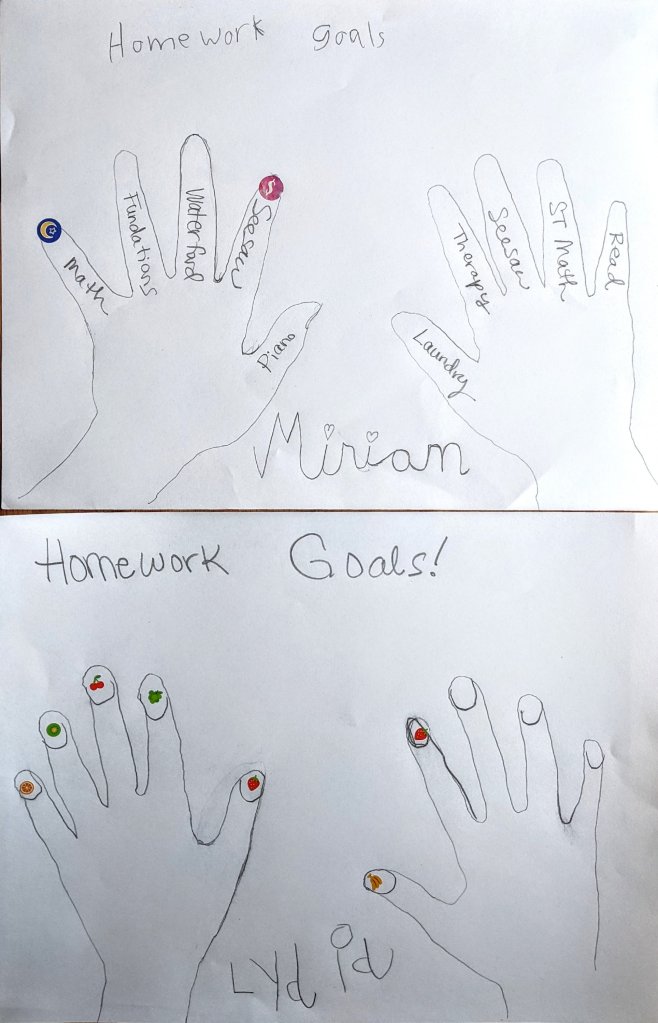
How I’m Helping My Kids Stay on Track for Homeschool During Quarantine

This is a picture of what I’m doing today to keep my youngest girls to stay on task with their school work. It matters to me that they’re motivated, rather than forced (otherwise it’s miserable for all of us!!) This has been the best strategy so far:

You don’t have to be an artist to create these simple hand-drawn charts to help track & visualize tasks for kids who are homeschooling.

You don’t need any special print-off; just trace their hands on a paper and write which actions earn them a sticker to put on each nail – or just use crayons if you don’t have stickers. Be as vague or specific as you need to be. Just keep it fun! The girls’ tasks here are divided into things like worksheet pages, 15 minutes at a time on math, reading a short book, as well as simple chores changing into their day clothes or clearing off their place at the table.

Ten is still a pretty big goal number, so I gave my littlest a bonus prize when she earned 5 stickers for the first hand, and the girls will each earn a manicure from Mommy once they’ve adorned all 10 fingers!

Traditional weekly fill-in-the blank charts were doing nothing for us, because they proved to be too abstract for a 5 and 7 year old. Then again, I can never expect that a chart will “do something” for me. Strategies fail quickly when they aren’t backed up by effort. Reminder charts have to be referred back to frequently so they get a chance to remind us to do the work. Having a visual strategy with short-term goal setting did really enhance their efforts, and the girls were happily referring back to these charts on their own!

This system is better than what we were doing before, because it visually displays how they’re progressing overall, rather than waiting all day for any benefits as they go through the mental list (usually I would just end up enduring the push-pull cycle!) This is also preferable to receiving little rewards for EACH step in the right direction, because they’re still getting some delayed gratification.

My kids’ school allows them to be self-paced, which has its own challenges, but I imagine visualizing a “countdown” could also be useful for those children who seem to have endless Zoom meetings.

I have a bonus tip which I’ve shared with some of my other young clients who have to endure back-to-back zoom meetings: Make tally marks as you listen to lectures. Use two categories, labeled “Stuff I already know” and “Stuff I didn’t know before” (or “New” and “Review”). This simple system gives your brain something to scan for, and scanning requires a lot less effort (and therefore requires less motivation) compared to the expected task of active listening. Think of scanning like when you’re in an environment with a lot of background noise and you hear your name; suddenly you pay attention! Your name is something your brain is programmed to scan for, without conscious effort. Depending on the subject, your brain could be casually scanning for “novel information” in order to try to add up tally marks. You might count your tallies to gauge how well you were listening. **Extra credit if you actually write down what the new information IS!!**

Have a better day!
Love,
Janina

How to Ask for Help When You’re Suffering

Author’s note: The bulk of this article was originally written for a stranger who had shared their struggle with suicidal thoughts, but I would give this same advice to anyone who struggles with mental health …or even just really big emotions! It doesn’t have to be extreme before it’s worth paying attention to what’s going on inside us.

It’s important to have someone you can be vulnerable with, even if they are anonymous. Everyone needs someone they can trust to tell their fears to. Many times the people we love feel uncomfortable when we share, so they don’t know what to do. They feel like their only options are to try to fix you, or to protect themselves from feeling so deeply, because it hurts so much. It takes a lot of strength to be with someone who is suffering and just allow it to run its course, even though often it’s the best thing they can do.

When you need to share your anxiety (and you need to) first tell the person what they can do for you. Preface the conversation with something like, “Can I share something with you? It’s awkward for me, and very personal, but I feel like I need to tell someone…” You might even add, “You don’t have to try to fix it or make it go away. All I really need is somebody to listen and be there.” (Or, if you know your Love Language, you could say that you just need a shoulder to lean on, or some words of encouragement, etc.)

This step of getting “permission” can save you from heartache and embarrassment. It prepares them to be there for you, and by answering affirmatively, they have committed to it. You can often gauge from someone’s reaction whether they are interested or cannot be trusted. It’s probably normal to see fidgeting, or even lack of eye contact (they might just need a moment to adjust to the intensity), but someone who scoffs, shakes their head, changes the subject or just plain walks away isn’t ready yet. On the other hand, someone who can maintain their focus, or even increases their attentiveness when they hear your words, is preparing themselves to be there for you. The same people who might seem cruel when they don’t know what to do with themselves have the potential to be good to you if they have enough clarity (and if they aren’t surrounded by negative peer pressure).

Keep in mind you are more likely to get a negative response if the person you are planning to talk to is the person who is causing the problem you’d like to talk about. Sometimes, when you’re feeling stepped on our disregarded, you just need someone else to speak up to them on your behalf. A third party could also help you find the words to be assertive, yet kind. You might share with your trusted confidante that you’re not trying to make anyone look bad, but you would like guidance on how to gently work out the situation. (PS, coaches can be good for this, too!)


The important thing is not to wait until you are near the breaking point. It’s important to tell someone at the first sign of trouble, so you have time for several “failed” tries to share your troubles if you realize you either can’t trust someone, or they aren’t emotionally ready for you. By searching for help right away, there is still time to keep trying until you find someone who understands that you need someone who cares, long before you’re at your breaking point. This is a skill. You will get better at it, and so will they.

Another note: Often adolescents don’t understand how to get our attention, and if you have a very angry adolescent on your hands, consider taking the time to teach them how best to get your attention, rather than just reacting badly when they start badly. Often when they’re being a problem, it’s because they’re having a problem. When you’re prepared, you can respond to them in a helpful frame of mind, you won’t accidentally dismiss a problem or get defensive and start a whole new problem. It is one of the best lessons they can learn, because it helps them get the help they need, now and into adulthood.

I am an avid student of interpersonal communication, and I believe the way we get someone’s attention is every bit as critical as the thing we have to say. Believe that the other person wants to help you. Help them help you.

I pray you will find a trusted confidante. It could a be a sister or brother, maybe you haven’t communicated with in a while. Get their permission before you disclose, and it could be nearly anyone you’d expect you could trust. Be a strength to them, too, when they fall on hard times, as well as when they need someone by their side to celebrate life’s good moments. Happiness isn’t as joyful when you have no one to share it with. Share the joy they have to offer. ♥️