Parents need to take care of themselves in order to be ready to tackle the next challenge that comes along – which is constantly. How do we even begin to get a moment to ourselves? Most commonly it’s through stolen moments of screen-scrolling, and that is shown to actually drain our capacities, not increase them (Mostafavi, 2016).
Often our smartphone use is really a form of avoidance, and in the long run, avoidance is so stressful. I noticed that for me, the cycle becomes doing what I can get away with in the moment – because I finally have a moment – and my life is so hard that I deserve a moment for myself to do what I want! That’s okay, but it’s important to be mindful about the choices we’re making about how to these moments. If we choose something that just makes time pass, they cause zip toward the next hard thing, especially if I have been using electronics to avoid the hard things for most of the day.
I read an inspirational quote today. It said “Self-care isn’t about hot chocolate and bubble baths, it’s about having a life you don’t feel like you need to escape from” (Siddique, 2020).
Make life easier by facing the tough stuff!
Productivity and purpose make people happier. But how do we do it? One paradox of productivity is that we must be willing to have some things NOT get done in order to have the most essential things get done. If you’re disorganized, chances are you sometimes feel like prioritizing feels irresponsible. It is about choosing which things you will NOT do. It’s somehow satisfying to get to the end of your day and say, “At least I tried to do it all. Nobody could say I didn’t try!” …. But we have no business trying to do it all! Our business is to figure out only a couple things and learn to own the fact that the things which didn’t get done were ignored intentionally because you didn’t make a conscious effort to focus on them.
But don’t stick to ONLY tough stuff!
Here’s a pro tip: let’s not go too black and white on our thinking here. Don’t plan to only focus on the boring, horrible things or you will give up planning as a lifestyle and go back to being a victim of circumstance! This is where self-care comes in. Can we be real about what we can fit into a day? Can we be sure we have at least one item on our calendar (or option list) that brings a lot of personal satisfaction? It might be organizing one corner of your desk, or chatting on the phone with a friend, or maybe turning on some music and dancing like a fool. My sister feels she has received self-care when she’s had time to do her makeup and look her best. What minor upgrade are you craving today? Let it be something that leaves you feeling better than when you started. That way you’ll have MORE juice for giving to those kiddos, not less.
You know the scenario. You dread taking your preschooler shopping with you. He’s screaming at the top of his lungs that he wants to get the Captain Fruit Lollies, and you are trying not to make eye contact with fellow shoppers who have stopped to stare. You shrink with shame and dread. At least he is somewhat contained in the shopping cart, but what are you going to do when he’s too big for shopping carts and still throwing tantrums in the store?
Dr. Haim Ginott (1973) explains that we may actually encourage our child’s misbehavior with our own self-defeating behaviors. Here are some suggestions that will gradually begin to improve your out-of-home experience:
1. Be proactive – discuss expectations before you go somewhere, such as which behaviors would end a play date, or how much money they have to spend at the store (preferrably money they’ve earned). Regardless of its source, experts advise sticking with a set amount even if it means leaving behind something they really wanted (Martinelli, 2023). You can feel sympathy for their disappointment and still not give in. That isn’t “mean”, these are valuable life lessons.
2. Be even more proactive – work on refining your parenting techniques at home. If you’ve given in too many times when they’ve begged for a movie past bedtime, or when they wanted junk food instead of the dinner you made, then they’ll know they’re the one in charge. Note: if you discussed an arrangement you were both happy with, that is not the same as “giving in.” If they don’t budge until you’ve threatened them within an inch of their life, then going out in public is probably not going to go well – you won’t want to get angry like that in front of other people. Find a public-appropriate way of talking to them, and talk to them that way at home, too. Remember, the goal isn’t always compliance. Sometimes it’s just understanding.
3. Follow-through with any predetermined consequences (no bribes, no empty threats). Be prepared to interrupt what you’re doing in order to remove them if the situation goes downhill. Don’t think of it as wasted time, but as an investment in future peace and cooperation. Go ahead and be a leader here.
4. Direct respect toward the owner of the home or restaurant, house of worship or shop you’re in. Make a big deal about figuring out what their rules are and following them. Let your children see you desiring to be obedient (rather than seeing you resenting rules and trying to justify your way around them). Demonstrate all the politeness you hope to see from them in the future.
5. Discipline out of necessity, not out of embarrassment. Don’t parent for the sake of what everyone else thinks. Be willing to be different, to be disapproved of, especially if you know what you’re doing is right. It’s your relationship with your child that will matter years from now, not your reputation with strangers.
6. Pick your battles. Remember, obedience isn’t our ONLY parenting goal! Is this thing something you want to fight for? (If they know you’re more likely to let something slide in public and they’re taking advantage of that, or they are doing that one thing you have already talked about, then yes. Pick this battle.)
7. Don’t back down. If you already picked a battle, you can’t let them win it through rude and disrespectful behavior. (You can be willing to listen and be flexible if they politely advocate for their wants and needs. That’s not the same as giving someone what they were screaming for all through the store just to get them to be quiet! Giving in to a child who is demonstrating unacceptable behavior would be trading a short-term gain for a long-term loss, and parenting is all about the long game.
8. Follow up. Discuss how the outing went after it’s over. Try to remember to do this whether the behavior was good, bad or ugly. Be specific in the way you praise them, and describe the effect their actions had, rather than assigning a value to it. For example, “Thank you for a pleasant shopping trip. You opened the doors when I was carrying the groceries to the car, that made it a lot easier for me!” (There’s a whole philosophy behind this, but basically you are teaching your child to be less dependent on your praise for warm-fuzzies, but instead feel good for the sake of the good they did for others.)
9. What’s wrong? Maybe they’re hungry or thirsty or it’s halfway through naptime. It’s hard to plan everything perfectly, but try to make shopping trips at a time of day that you’re both in a good mood. Maybe it’s just that the iPad is dead and they don’t know how to do a grocery store without it. Be cautious about being over-reliant on electronics for peace. That’s another short-term gain, long-term loss.
10. Have realistic expectations for their age. If you’re hoping a preschooler will never make a fuss, never have an opinion, and not bother you at the wrong moment, then you’re better off going it alone. Otherwise, you will both be miserable. Just have predetermined boundaries before you go.
This is all going to take some time and practice, so remember you’re not alone the next time you’re going down the aisle with a screaming child. Look your fellow shoppers in the eyes and give them a sympathetic smile. Many of them already know what this is like. Maybe when you look up, they’ll already have a smile waiting for you.
References:
Ginott, H. (1973) Between Parent and Child. Macmillan.
So, your child has a device and you’ve discovered something you were hoping you’d never see. Or maybe you just heard about the scary things that are out there! Now what?
Step 1 – Don’t panic. The human brain’s natural reaction to stressful news is known as fight or flight – get mad or get scared. Both of those are reactions that flood your brain with cortisol. You can’t fully access the benefits of your cerebral cortex when you’re angry or afraid (Pederson, 2018). Ever notice that when you are in emotional overload is when you tend to make bad choices?
Step 2 – Don’t ignore it. Your brain wants to protect you from overload AND prevent conflict/danger/difficulty, so stay mindful. Don’t let your brain’s natural programming retreat to somewhere comfortable. Often, something seems awful right BEFORE you actually jump in and take it on. Don’t ignore the problem under any guise. Don’t tell yourself “I just respect their privacy” unless it’s truly a minor offense that’s better off being ignored than confronted. Check yourself, are you fearful? Then do what you need to do to get ready to take it on.
Step 3 – Get informed (and get support) here are some links to good advice on specifics for how to help your child manage their device. The information is constantly updating, so here I will refer you to some of my favorite resources for the latest research:
Step 4 – Be honest (you might need to practice your words first) Have a conversation. If you are dreading the conversation, get a mediator by your side (and another by theirs, if that helps). Clarify why it is you are stepping in. Give enough information necessary to inform them, but not to frighten them. This is a moment for vulnerability, not condemnation or demanding uncontested control.
Step 5 – Show love & empathy. Keep developing the relationship. Commit to continuing to learn about parenting – be open to learning new concepts and techniques that help you understand them and show empathy. Use discipline as a guide, not a weapon. You can’t protect them from everything, but that shouldn’t stop you from trying! Open the channels of communication and try to comprehend. How well you listen to them will have an enormous influence on how well they’ll listen to you. Listening and understanding do not automatically equate to agreeing or condoning. We can be understanding about how hard it is even as we’re insisting it has to be that way. Sometimes love means being willing to feel some of someone else’s pain.
Step 6 – Plan together what you will do next. Show them the decision you’ve made for screen-monitoring, blocking or filtering options based on your current research (make sure you’re aware which operating system your child’s device uses), then let them help you form the plan for when, what, and for how long. Plan in advance to be open to their input (make an informed decision, not an emotional one), but it’s easier to start strict and lighten up than it is to bear down after they’re accustomed to having a free-for-all. This is like using guard rails on the highway or baby proofing around the house – it may seem restrictive, but it’s for their protection. Let them know you’ll continue to adapt as they grow, but in addition to monitoring they need screen-free time to be able to develop social skills and impulse control (Grover, 2017).
Step 7 – Project Confidence. Kathy Koch, PhD, author of “Screens and Teens” (2015), advocates the idea that we are in the business of motivating our kids to internalize values that lead to good choices. She says we are not as effective when we are merely monitoring their choices and inflicting consequences when we see an error. Top-down, authoritarian parenting encourages rebellion, secrecy and feelings of shame. Fearful, passive parenting also doesn’t help our children develop in healthy ways, it’s a way to excuse ourselves from the unpleasantries involved in parenting. If we shouldn’t be dominant but we shouldn’t be passive, then what else is there? Confident, assertive, and empathetic parents. Set reasonable and firm boundaries, parent proactively to help increase the odds of success.
Step 8 – Follow up. When something happens outside the plan, and it inevitably will, don’t take it personally, but do take a stand. A passive parent who allows their child make all choices or protects them from the consequence of their choices is acting out of fear – fear of loss of their love. A dominant parent who refuses to be flexible with their child is also parenting out of fear – fear of loss of control. “Parenting should be neither passive nor aggressive, but assertive. You are the leader, but you are a wise, caring leader” Lawrence, 2010).
Traditional marriages often fall into traditional roles, but this doesn’t need to be the case. Let him hear from you.
Married women have just as much right to choice in their lives as single women do. Yes, you are committed to the union! Does that mean you now give up all semblance of happiness when you approach the altar of marriage? No, temporary peace comes at a high cost.
Do you realize what an uneven level of sacrifice does to your marriage? It doesn’t strengthen your union; it fosters resentment. Eventually, resentment will build inside you. Guilt or apathy is likely what you’ll receive from your partner, because he won’t know your experience if you never told him.
Challenge him, challenge his thinking. Be his true partner. I am writing this post because I’m thinking of some women I know who behave (or teach their daughters to behave) as if the relationship is so fragile that it’s going to fall apart they stand up and say something “wrong”. They’re afraid to tell him that something is wrong.
If you treat a relationship like it’s THAT fragile, it will be.
Some issues are too insignificant to worry about, and others are not easily solved. But letting everything get swept under the rug in the name of “keeping the marriage together” is making for an incredibly unbalanced, unhealthy relationship. I don’t just mean equality for women as a principle, I mean for each of you to develop a general attitude and behavior of caring about what each other is experiencing. Not to prove you’re a good wife, but because you actually care about what each other is experiencing.
Give him a chance. Give him a chance to be the good guy; a chance to know what you are really thinking and feeling. Don’t wait for the frustration to build to a boiling point, or you may make an enemy rather than make a point.
What about him? What if his ego is fragile? Well, let’s hope he’s not completely egotistical, but if he is, it’s better to know it, rather than tiptoe and pretend it’s not true.
I’m not talking about asserting your opinion or authority above another person. That’s just the same problem in reverse. I am saying to be assertive enough to let him know what you’re thinking and how you are feeling. Communicate it in a way that shows you believe he cares about what you’re thinking and how you are feeling.
If he is going to act against your better judgment, he should at least know what that judgment is. Then at least you can truly know whether or not he is deserving of the resentment you’ll inevitably feel toward him if he steamrolls you.
Women have traditionally been taught to be passive. We’re taught to keep the peace. Sometimes I struggle when I find myself needing to say something that contradicts what my husband has just said. It’s hard because I feel like I’m rocking the boat. This is how we contribute to “the patriarchy”; we let his assertiveness be met only by our desire to get along.
Women, being sensitive to social situations, sometimes feel as if having an opinion makes us automatically responsible for the his reaction to their opinion (am I right?) We are not responsible for their reaction, but we are responsible for our delivery.
But what if he never hears your opinion? Then how can he act on it? Women have been traditionally told to never complain. Remember, a suggestion is not a complaint. A new perspective should be welcome in a stable marriage relationship. You are doing both of you a disservice if you always keep quiet.
Something women do automatically is ask each other a lot of questions, and invite a lot of feedback. Men do not automatically do this. Therefore, women tend to automatically feel that someone who communicates in a more masculine way has laid down the law and is very, very firm in their decision, when really it’s just a difference in communication style. If you feel timid in bringing up a point you fear he’s not ready to hear, consider just asking it as a question.
“May I make a suggestion?”
If he says no, then that means he had to hear himself telling you that you are not allowed to make a suggestion. It helps him reveal his true character.
What is the consequence of him not knowing your true feelings on things? What if you go along very easily with everything, in an attempt to never contradict or complain. Then you rob not only yourself, but you also rob him of two things. You rob him of the chance to get to know his real wife, and you rob him of the opportunity to grow by taking another person’s perspective into consideration.
It is best for both of you if you consider yourselves as a partnership.
What do people become if they only see success and never meet with any resistance? They become spoiled. Entitled. They do not know what a good thing they have.
So, speak up! Disagree agreeably. Not with fear, but with courage. With the confidence of knowing this is a good man, and you are a good woman, and you are a partnership. Do not spoil him with your silence. Help him rise to the occasion and become who he is destined to become.
Another reason it’s easy to be passive is because before we were women, we were children. If we were parented traditionally, then we were encouraged to keep our opinions to ourselves, because the grown-ups don’t often want to hear the opinions of children.
Men who call women nags are the same men who are not interested in hearing from them in the first place. There is not necessarily anything wrong with that woman. However, she may be speaking in a way that is passive aggressive, because she was never invited to be assertive. If you’re waiting to be invited; don’t wait anymore. Men don’t invite each other to be assertive; they just are. If you are assertive, too, then a good man will respect you for it. It will STRENGTHEN the marriage, not weaken it. If the relationship is weakened when you are being strong, then what does that say about the relationship?
Don’t wait for him to ask what you think
Babies who are ignored tend to cry. Women who are ignored tend to complain. It is every bit as much his responsibility to take care of this marriage as it is yours. Elevate him to the status of one who is an equal partner with his wife.
Do not abdicate the responsibility of all decision-making to him. That’s cheap. That way you get the right to be unhappy about all of his decisions, since you took no part in them. You get to maintain a victimhood status. Taking an active role in the decisions means you don’t get to sit back and blame someone else for the decisions. But it does mean you are empowered far beyond what you would be if you only had the power to blame someone else.
Married men are much healthier than single men of the same age. We do a good job taking care of our men, by and large. But we do them a disservice if we do not help him to grow his character. If we are disgruntled pushovers, obligated to uphold his every word in every situation. Don’t treat him like he’s a monarchical dictator (you certainly don’t want him to become one).
I cannot overstate the importance of believing this is your right and your duty. Otherwise you will speak like a petulant child; a teen who is complaining that their parents never listen to them. This is not a good place for him to be acting well from. Give him the benefit of the doubt that he actually cares for you. Give him the chance to be a good man.
Too many men are living beneath their potential because of women who will not speak up in good faith. That means they only speak up out of exasperation, and how does that sound from the other end? It sounds like you’re complaining about your boss. It sounds like you’re making him out to be the bad guy. But you didn’t marry a bad guy, you married a good man.
With work, you can learn to see eye to eye
Believe he is that man. Have faith that he is a good man. Believe he can rise to the challenge of meeting the requests of his wife by sharing those requests with confidence and love. Most men are pleased to bend over backwards to make their wives happy. Just be sure to say it as a request between equals.
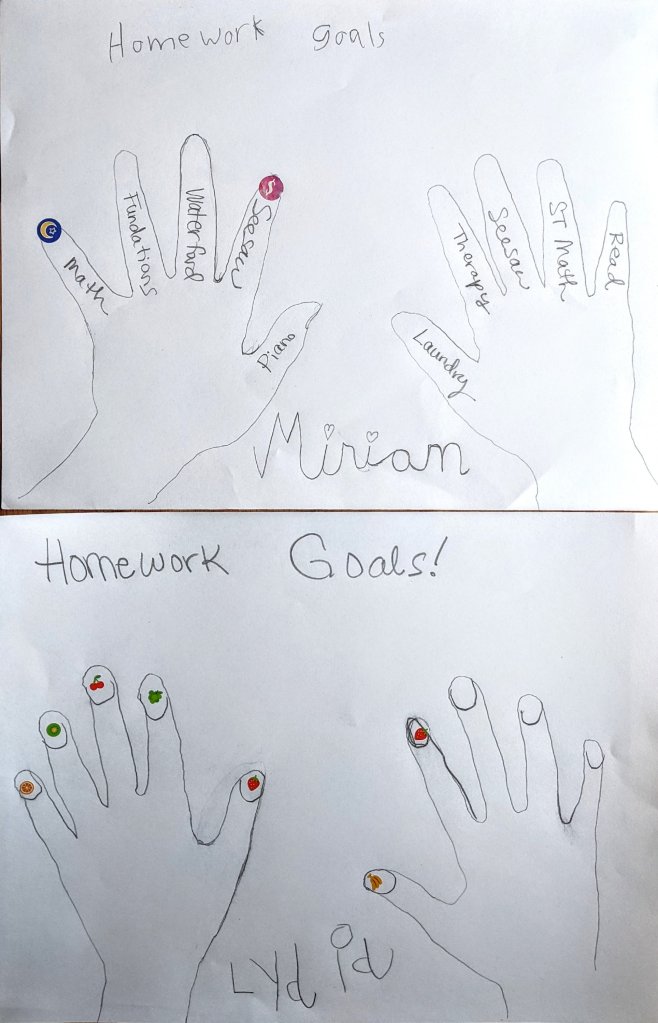
This is a picture of what I’m doing today to keep my youngest girls to stay on task with their school work. It matters to me that they’re motivated, rather than forced (otherwise it’s miserable for all of us!!) This has been the best strategy so far:
You don’t have to be an artist to create these simple hand-drawn charts to help track & visualize tasks for kids who are homeschooling.
You don’t need any special print-off; just trace their hands on a paper and write which actions earn them a sticker to put on each nail – or just use crayons if you don’t have stickers. Be as vague or specific as you need to be. Just keep it fun! The girls’ tasks here are divided into things like worksheet pages, 15 minutes at a time on math, reading a short book, as well as simple chores changing into their day clothes or clearing off their place at the table.
Ten is still a pretty big goal number, so I gave my littlest a bonus prize when she earned 5 stickers for the first hand, and the girls will each earn a manicure from Mommy once they’ve adorned all 10 fingers!
Traditional weekly fill-in-the blank charts were doing nothing for us, because they proved to be too abstract for a 5 and 7 year old. Then again, I can never expect that a chart will “do something” for me. Strategies fail quickly when they aren’t backed up by effort. Reminder charts have to be referred back to frequently so they get a chance to remind us to do the work. Having a visual strategy with short-term goal setting did really enhance their efforts, and the girls were happily referring back to these charts on their own!
This system is better than what we were doing before, because it visually displays how they’re progressing overall, rather than waiting all day for any benefits as they go through the mental list (usually I would just end up enduring the push-pull cycle!) This is also preferable to receiving little rewards for EACH step in the right direction, because they’re still getting some delayed gratification.
My kids’ school allows them to be self-paced, which has its own challenges, but I imagine visualizing a “countdown” could also be useful for those children who seem to have endless Zoom meetings.
I have a bonus tip which I’ve shared with some of my other young clients who have to endure back-to-back zoom meetings: Make tally marks as you listen to lectures. Use two categories, labeled “Stuff I already know” and “Stuff I didn’t know before” (or “New” and “Review”). This simple system gives your brain something to scan for, and scanning requires a lot less effort (and therefore requires less motivation) compared to the expected task of active listening. Think of scanning like when you’re in an environment with a lot of background noise and you hear your name; suddenly you pay attention! Your name is something your brain is programmed to scan for, without conscious effort. Depending on the subject, your brain could be casually scanning for “novel information” in order to try to add up tally marks. You might count your tallies to gauge how well you were listening. **Extra credit if you actually write down what the new information IS!!**
Admission: I have spent several months with one foot in my business project, and one foot in being a stay-at-home mom (that was my full-time gig up until this year when my youngest daughter started preschool – now it’s only most of time!) I find myself not really being able to give my heart to either very effectively in the moments that I need to. Over the years I’ve become anxious of taking the plunge into ADD-hyperfocus mode, which has kept me just short of finishing some fabulous ideas which are sitting at about 90% done. I want to do more.
Today I started a Skillshare class, and it is REALLY good, you guys! It’s by motivational speaker and life coach TJ Walker, and he calls it How to Organize your Home Effectively. I knew I would get more motivated to tackle the house if I watched it listened to something on the subject. One of the important questions he asked is for us to define our “why?”
My why: I want to feel unburdened so I can start my blog/business without all the guilt. I’ve heard that clutter is a result of indecision, and I’m finding clutter also creates MORE indecision, since I can’t decide whether to work on the clutter or something more meaningful to me.
So now as I approach decluttering, I’m thinking it’s actually best for me to cultivate a mindset, not motivation and willpower and focus, or determination and endurance. I need to just get in the mindset of being decisive. I don’t even need to feel “inspired”. I don’t even need to do it for very long at once.
Being decisive doesn’t mean I know I’m making “the right choice”. It means I’m able and willing to handle the consequences of whatever choice I make. It’s kind of like being… Confident.
There you go, a little motivation for both of us and a blog post written in only 30 minutes! Write YOUR “why” in the comments; in other words, the reason you want to do this hard thing, whatever is staring you in the face, then go do it! 🥰
Update: Important realization – I still had to get myself used to the idea of doing it even once I made the decision. Once I started, I gradually gained momentum. Nowhere near where I want to be, but I can’t expect to do it all in a day (maybe that’s why I keep hesitating? Is that my unrealistic expectation?) I am glad to have the advice from any geniuses out there with suggestions for keeping up on papers!
“I am convinced that life is 10% what happens to me and 90% how I react to it.”
Charles R. Swindoll
The other day my youngest daughter was putting up our play chairs all in a row to make a path for her to walk across. The problem was that her path was blocking my path. As I came up to her creation, my hands were full of things I was trying to carry to the kitchen.
“Great,” I muttered to myself, “now I can’t get through.”
My daughter had “blocked” my way with chairs, and the other end of the table was even more blocked because we’re remodeling. I decided she’d better move her little project somewhere else.
“Wait, what?” I questioned myself, “Did I seriously just say Ican’t about this tiny little problem? This obstacle is totally surmountable!”
My daughter came in the room and asked innocently, “Do you like the path I made?”
“Yes, I do!” I proclaimed. Honestly, I didn’t even have to move the row aside in any way, I only had to step over to get to the other side. Fortunately for her, Mommy had been learning about perceived mental barriers, otherwise I might have felt irritated or even overwhelmed. Instead I was excited, and I wanted to share my insight with you!
I felt cheerful every time I saw the “Great Wall of Chairs” that I had to step over, because my brain was continually registering the assignment as impossible, and I kept practicing overriding that thought. It was strangely empowering. I was even motivated to sweep the floor (well enough to take a picture). 😉
Not every obstacle we run up against is so simple. Life is complicated and life is hard, but try to avoid telling yourself, “it’s TOO hard.” That’s called mental resistance. Having mental resistance about a problem we face only makes it more difficult to solve, or more difficult to endure.
Your brain is programmed to protect you from expending too much energy, and it tells you to avoid anything difficult or stressful. That kind of programming can work for us or against us. Don’t be afraid of the effort it will take to tackle a problem that at first seems too hard to face; or to experience a feeling that seems too hard to feel.
Those of us with ADHD experience a LOT of mental resistance when it comes to doing the most ordinary, mundane things. Rather than trying to escape, next time you run up against a wall of something you “can’t” get over, challenge that thought. Doubt what your brain is programmed to tell you, and see if your problem really can be overcome. Perhaps with more effort, and more external support, I hope you can feel empowered to do all kinds of things you never thought you could!
That is one of the great hopes I have for this blog; that it will inspire you to reach and grow beyond your own expectations. Start small, and when you notice an obstacle, you can think of it as an opportunity to practice overcoming.
Share what you learn! I’m excited to see what you come up with, and how a difference in perspective changed an experience for you!
A person with ADHD is, first and foremost, a person. If you are also a person, you might enjoy the content of this blog. 😉
This is particularly true if you have ever experienced any of the following “symptoms”:
You have procrastinated
You’ve gotten distracted
You’ve been forgetful
You’ve struggled to get organized
You’ve struggled to prioritize
You’ve felt overwhelmed or “scattered”
You’ve been disappointed in how little you accomplished
Also if you:
Care about someone with ADHD and want to understand how to better relate to or assist them (good for you!)
Have imagination and can apply wisdom from someone else’s life to your own life, even though you don’t have exactly the same life! 😀
What if I don’t even believe ADHD is real?
That’s nothing we need to quarrel about. Consider any mention of ADHD to be shorthand for regular people who struggle sometimes with executive functioning skills (see list of “symptoms”, above). I believe the struggle is more or less universal, especially now that we have devices that can soothe and distract us at any time of day or night.
I don’t plan to promote any specific dietary or pharmaceutical intervention, or even natural remedies. I will leave that part of the discussion to the professionals.
I do encourage people to do some things for their general well being (such as regular sleep, exercise, developing confidence, nurturing healthy relationships, etc.)
I’ve lived it! I’ve been gradually learning how to turn my ADHD from a liability to an asset.
So, if you are someone who has a general fascination with the human brain and behavior and would enjoy reading a unique perspective on the subject, or better yet if you want real-life strategies to apply what you’ve learned, then WELCOME! This blog is for you
My aim is to share habits, strategies and coping skills that can help shape positive mindsetandbehavior. I feel that focus on these areas is a necessary part of any person overcoming any obstacle, whatever their struggle may be.





 Innovising