Is Your “Self Care” Actually a Form of Avoidance in Disguise?

Parents need to take care of themselves in order to be ready to tackle the next challenge that comes along – which is constantly. How do we even begin to get a moment to ourselves? Most commonly it’s through stolen moments of screen-scrolling, and that is shown to actually drain our capacities, not increase them (Mostafavi, 2016).

Often our smartphone use is really a form of avoidance, and in the long run, avoidance is so stressful. I noticed that for me, the cycle becomes doing what I can get away with in the moment – because I finally have a moment – and my life is so hard that I deserve a moment for myself to do what I want! That’s okay, but it’s important to be mindful about the choices we’re making about how to these moments. If we choose something that just makes time pass, they cause zip toward the next hard thing, especially if I have been using electronics to avoid the hard things for most of the day.

Woman pauses laundry on sofa, distracted by her phone.
Photo by Karolina Grabowska on Pexels.com

I read an inspirational quote today. It said “Self-care isn’t about hot chocolate and bubble baths, it’s about having a life you don’t feel like you need to escape from” (Siddique, 2020).

Make life easier by facing the tough stuff!

Productivity and purpose make people happier. But how do we do it? One paradox of productivity is that we must be willing to have some things NOT get done in order to have the most essential things get done. If you’re disorganized, chances are you sometimes feel like prioritizing feels irresponsible. It is about choosing which things you will NOT do. It’s somehow satisfying to get to the end of your day and say, “At least I tried to do it all. Nobody could say I didn’t try!” …. But we have no business trying to do it all! Our business is to figure out only a couple things and learn to own the fact that the things which didn’t get done were ignored intentionally because you didn’t make a conscious effort to focus on them.

But don’t stick to ONLY tough stuff!

Here’s a pro tip: let’s not go too black and white on our thinking here. Don’t plan to only focus on the boring, horrible things or you will give up planning as a lifestyle and go back to being a victim of circumstance! This is where self-care comes in. Can we be real about what we can fit into a day? Can we be sure we have at least one item on our calendar (or option list) that brings a lot of personal satisfaction? It might be organizing one corner of your desk, or chatting on the phone with a friend, or maybe turning on some music and dancing like a fool. My sister feels she has received self-care when she’s had time to do her makeup and look her best. What minor upgrade are you craving today? Let it be something that leaves you feeling better than when you started. That way you’ll have MORE juice for giving to those kiddos, not less.

Mom and daughter ice a bundt cake.
Photo by Any Lane on Pexels.com

We can really find freedom from needing to find freedom by doing the work it takes to create the life that we truly want.

Mostafavi, B., (2016). Plugged in parenting: How parental smartphone use may affect kids. University of Michigan. https://www.michiganmedicine.org/health-lab/plugged-parenting-how-parental-smartphone-use-may-affect-kids

Siddique, H. (2020). Self-care is often a very unbeautiful thing. Embolden Psychology. https://embolden.world/self-care-is-often-a-very-unbeautiful-thing/#:~:text=True%20self%2Dcare%20is%20not,the%20eye%20and%20re%2Dstrategizing.

10 Ways to Help Your Child to Behave in Public

You know the scenario. You dread taking your preschooler shopping with you. He’s screaming at the top of his lungs that he wants to get the Captain Fruit Lollies, and you are trying not to make eye contact with fellow shoppers who have stopped to stare. You shrink with shame and dread. At least he is somewhat contained in the shopping cart, but what are you going to do when he’s too big for shopping carts and still throwing tantrums in the store?

Dr. Haim Ginott (1973) explains that we may actually encourage our child’s misbehavior with our own self-defeating behaviors. Here are some suggestions that will gradually begin to improve your out-of-home experience:

1. Be proactive – discuss expectations before you go somewhere, such as which behaviors would end a play date, or how much money they have to spend at the store (preferrably money they’ve earned). Regardless of its source, experts advise sticking with a set amount even if it means leaving behind something they really wanted (Martinelli, 2023). You can feel sympathy for their disappointment and still not give in. That isn’t “mean”, these are valuable life lessons.

2. Be even more proactive – work on refining your parenting techniques at home. If you’ve given in too many times when they’ve begged for a movie past bedtime, or when they wanted junk food instead of the dinner you made, then they’ll know they’re the one in charge. Note: if you discussed an arrangement you were both happy with, that is not the same as “giving in.” If they don’t budge until you’ve threatened them within an inch of their life, then going out in public is probably not going to go well – you won’t want to get angry like that in front of other people. Find a public-appropriate way of talking to them, and talk to them that way at home, too. Remember, the goal isn’t always compliance. Sometimes it’s just understanding.

3. Follow-through with any predetermined consequences (no bribes, no empty threats). Be prepared to interrupt what you’re doing in order to remove them if the situation goes downhill. Don’t think of it as wasted time, but as an investment in future peace and cooperation. Go ahead and be a leader here.

4. Direct respect toward the owner of the home or restaurant, house of worship or shop you’re in. Make a big deal about figuring out what their rules are and following them. Let your children see you desiring to be obedient (rather than seeing you resenting rules and trying to justify your way around them). Demonstrate all the politeness you hope to see from them in the future.

5. Discipline out of necessity, not out of embarrassment. Don’t parent for the sake of what everyone else thinks. Be willing to be different, to be disapproved of, especially if you know what you’re doing is right. It’s your relationship with your child that will matter years from now, not your reputation with strangers.

6. Pick your battles. Remember, obedience isn’t our ONLY parenting goal! Is this thing something you want to fight for? (If they know you’re more likely to let something slide in public and they’re taking advantage of that, or they are doing that one thing you have already talked about, then yes. Pick this battle.)

7. Don’t back down. If you already picked a battle, you can’t let them win it through rude and disrespectful behavior. (You can be willing to listen and be flexible if they politely advocate for their wants and needs. That’s not the same as giving someone what they were screaming for all through the store just to get them to be quiet! Giving in to a child who is demonstrating unacceptable behavior would be trading a short-term gain for a long-term loss, and parenting is all about the long game.

8. Follow up. Discuss how the outing went after it’s over. Try to remember to do this whether the behavior was good, bad or ugly. Be specific in the way you praise them, and describe the effect their actions had, rather than assigning a value to it. For example, “Thank you for a pleasant shopping trip. You opened the doors when I was carrying the groceries to the car, that made it a lot easier for me!” (There’s a whole philosophy behind this, but basically you are teaching your child to be less dependent on your praise for warm-fuzzies, but instead feel good for the sake of the good they did for others.)

9. What’s wrong? Maybe they’re hungry or thirsty or it’s halfway through naptime. It’s hard to plan everything perfectly, but try to make shopping trips at a time of day that you’re both in a good mood. Maybe it’s just that the iPad is dead and they don’t know how to do a grocery store without it. Be cautious about being over-reliant on electronics for peace. That’s another short-term gain, long-term loss.

10. Have realistic expectations for their age. If you’re hoping a preschooler will never make a fuss, never have an opinion, and not bother you at the wrong moment, then you’re better off going it alone. Otherwise, you will both be miserable. Just have predetermined boundaries before you go.

This is all going to take some time and practice, so remember you’re not alone the next time you’re going down the aisle with a screaming child. Look your fellow shoppers in the eyes and give them a sympathetic smile. Many of them already know what this is like. Maybe when you look up, they’ll already have a smile waiting for you.

References:

Ginott, H. (1973) Between Parent and Child. Macmillan.

Martinelli, K. & Anderson, D. (2023). Talking to kids about money. Child Mind Institute. https://childmind.org/article/talking-kids-money/

Tech for Tweens

So, your child has a device and you’ve discovered something you were hoping you’d never see. Or maybe you just heard about the scary things that are out there! Now what?

Step 1 – Don’t panic. The human brain’s natural reaction to stressful news is known as fight or flight – get mad or get scared. Both of those are reactions that flood your brain with cortisol. You can’t fully access the benefits of your cerebral cortex when you’re angry or afraid (Pederson, 2018). Ever notice that when you are in emotional overload is when you tend to make bad choices?

Photo by Sebastiaan Stam on Pexels.com

Step 2 – Don’t ignore it. Your brain wants to protect you from overload AND prevent conflict/danger/difficulty, so stay mindful. Don’t let your brain’s natural programming retreat to somewhere comfortable. Often, something seems awful right BEFORE you actually jump in and take it on. Don’t ignore the problem under any guise. Don’t tell yourself “I just respect their privacy” unless it’s truly a minor offense that’s better off being ignored than confronted. Check yourself, are you fearful? Then do what you need to do to get ready to take it on.

Step 3 – Get informed (and get support) here are some links to good advice on specifics for how to help your child manage their device. The information is constantly updating, so here I will refer you to some of my favorite resources for the latest research:

Step 4 – Be honest (you might need to practice your words first) Have a conversation. If you are dreading the conversation, get a mediator by your side (and another by theirs, if that helps). Clarify why it is you are stepping in. Give enough information necessary to inform them, but not to frighten them. This is a moment for vulnerability, not condemnation or demanding uncontested control.

Photo by Kindel Media on Pexels.com

Step 5 – Show love & empathy. Keep developing the relationship. Commit to continuing to learn about parenting – be open to learning new concepts and techniques that help you understand them and show empathy. Use discipline as a guide, not a weapon. You can’t protect them from everything, but that shouldn’t stop you from trying! Open the channels of communication and try to comprehend. How well you listen to them will have an enormous influence on how well they’ll listen to you. Listening and understanding do not automatically equate to agreeing or condoning. We can be understanding about how hard it is even as we’re insisting it has to be that way. Sometimes love means being willing to feel some of someone else’s pain.

Step 6 – Plan together what you will do next. Show them the decision you’ve made for screen-monitoring, blocking or filtering options based on your current research (make sure you’re aware which operating system your child’s device uses), then let them help you form the plan for when, what, and for how long. Plan in advance to be open to their input (make an informed decision, not an emotional one), but it’s easier to start strict and lighten up than it is to bear down after they’re accustomed to having a free-for-all. This is like using guard rails on the highway or baby proofing around the house – it may seem restrictive, but it’s for their protection. Let them know you’ll continue to adapt as they grow, but in addition to monitoring they need screen-free time to be able to develop social skills and impulse control (Grover, 2017).

Step 7 – Project Confidence. Kathy Koch, PhD, author of “Screens and Teens” (2015), advocates the idea that we are in the business of motivating our kids to internalize values that lead to good choices. She says we are not as effective when we are merely monitoring their choices and inflicting consequences when we see an error. Top-down, authoritarian parenting encourages rebellion, secrecy and feelings of shame. Fearful, passive parenting also doesn’t help our children develop in healthy ways, it’s a way to excuse ourselves from the unpleasantries involved in parenting. If we shouldn’t be dominant but we shouldn’t be passive, then what else is there? Confident, assertive, and empathetic parents. Set reasonable and firm boundaries, parent proactively to help increase the odds of success.

Photo by Monstera Production on Pexels.com

Step 8 – Follow up. When something happens outside the plan, and it inevitably will, don’t take it personally, but do take a stand. A passive parent who allows their child make all choices or protects them from the consequence of their choices is acting out of fear – fear of loss of their love. A dominant parent who refuses to be flexible with their child is also parenting out of fear – fear of loss of control. “Parenting should be neither passive nor aggressive, but assertive. You are the leader, but you are a wise, caring leader” Lawrence, 2010).

References:

Grover, S. (2017). “How technology lowers emotional intelligence in kids”, Psychology Today. https://www.psychologytoday.com/us/blog/when-kids-call-the-shots/201707/how-technology-lowers-emotional-intelligence-in-kids

Koch, K. (2015). Screens and teens: Connecting with our kids in a wireless world. Moody Publishers.

Lawrence, L. (2010). “Courageous Parenting”, October General Conference, Church of Jesus Christ of Latter Day Saints. https://www.churchofjesuschrist.org/study/general-conference/2010/10/courageous-parenting?lang=eng

Pedersen, T. (2018). “Why anxious minds can’t think right”, PsychCentral. https://psychcentral.com/news/2018/09/25/why-anxious-minds-cant-think-right#3

How I’m Helping My Kids Stay on Track for Homeschool During Quarantine

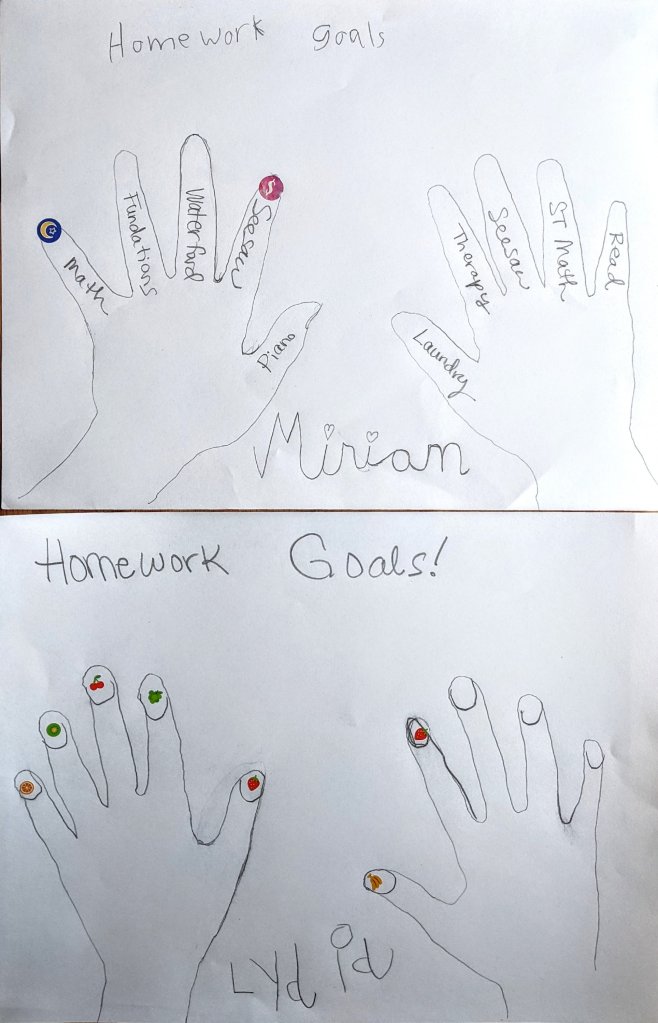
This is a picture of what I’m doing today to keep my youngest girls to stay on task with their school work. It matters to me that they’re motivated, rather than forced (otherwise it’s miserable for all of us!!) This has been the best strategy so far:

You don’t have to be an artist to create these simple hand-drawn charts to help track & visualize tasks for kids who are homeschooling.

You don’t need any special print-off; just trace their hands on a paper and write which actions earn them a sticker to put on each nail – or just use crayons if you don’t have stickers. Be as vague or specific as you need to be. Just keep it fun! The girls’ tasks here are divided into things like worksheet pages, 15 minutes at a time on math, reading a short book, as well as simple chores changing into their day clothes or clearing off their place at the table.

Ten is still a pretty big goal number, so I gave my littlest a bonus prize when she earned 5 stickers for the first hand, and the girls will each earn a manicure from Mommy once they’ve adorned all 10 fingers!

Traditional weekly fill-in-the blank charts were doing nothing for us, because they proved to be too abstract for a 5 and 7 year old. Then again, I can never expect that a chart will “do something” for me. Strategies fail quickly when they aren’t backed up by effort. Reminder charts have to be referred back to frequently so they get a chance to remind us to do the work. Having a visual strategy with short-term goal setting did really enhance their efforts, and the girls were happily referring back to these charts on their own!

This system is better than what we were doing before, because it visually displays how they’re progressing overall, rather than waiting all day for any benefits as they go through the mental list (usually I would just end up enduring the push-pull cycle!) This is also preferable to receiving little rewards for EACH step in the right direction, because they’re still getting some delayed gratification.

My kids’ school allows them to be self-paced, which has its own challenges, but I imagine visualizing a “countdown” could also be useful for those children who seem to have endless Zoom meetings.

I have a bonus tip which I’ve shared with some of my other young clients who have to endure back-to-back zoom meetings: Make tally marks as you listen to lectures. Use two categories, labeled “Stuff I already know” and “Stuff I didn’t know before” (or “New” and “Review”). This simple system gives your brain something to scan for, and scanning requires a lot less effort (and therefore requires less motivation) compared to the expected task of active listening. Think of scanning like when you’re in an environment with a lot of background noise and you hear your name; suddenly you pay attention! Your name is something your brain is programmed to scan for, without conscious effort. Depending on the subject, your brain could be casually scanning for “novel information” in order to try to add up tally marks. You might count your tallies to gauge how well you were listening. **Extra credit if you actually write down what the new information IS!!**

Have a better day!
Love,
Janina

Quarantine Halloween!

Who says March 31st can’t be Halloween if we want it to be? The world is a little upside-down right now anyway!

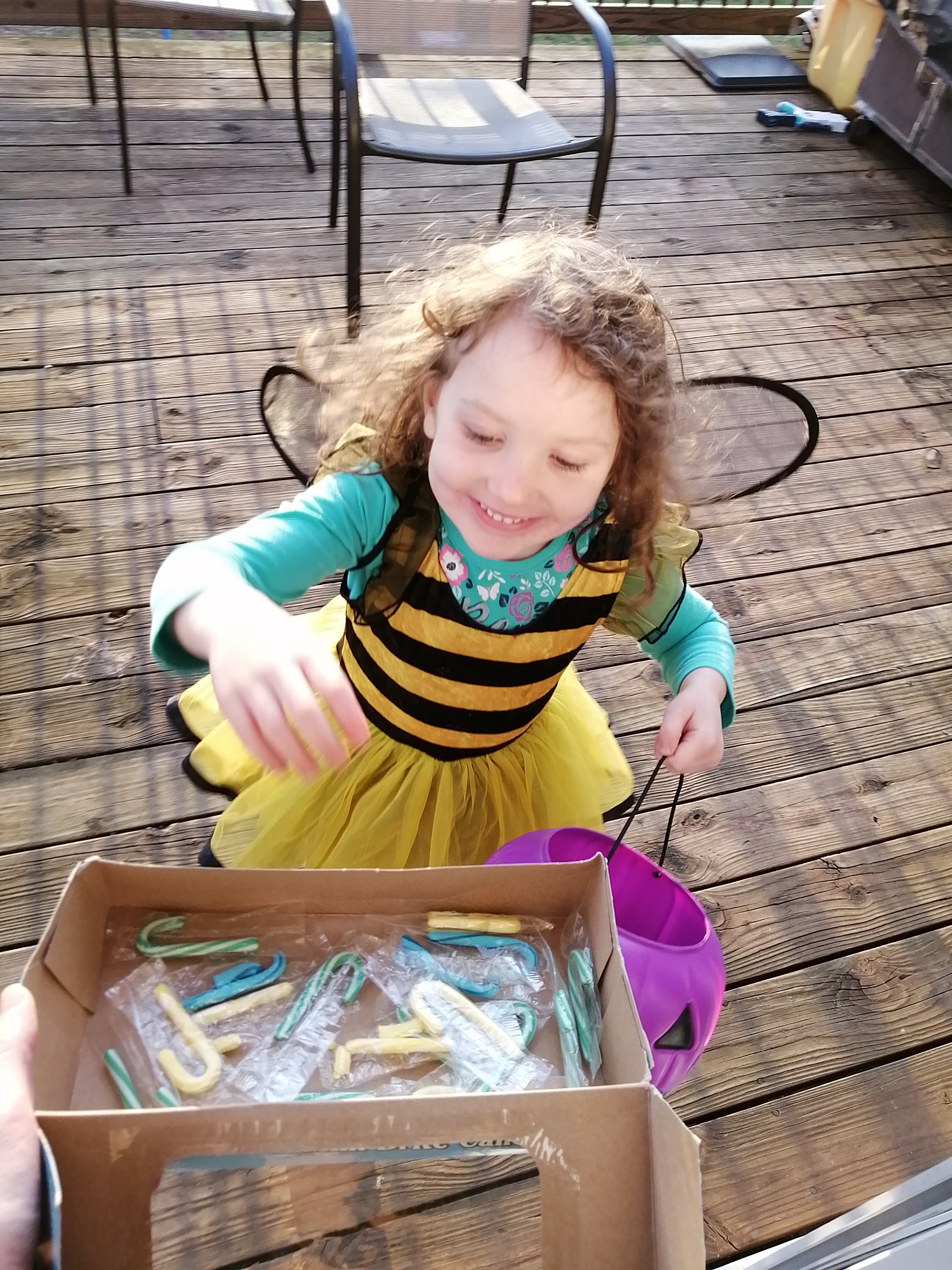
The kids ran from the front door to the back, but this could easily be done inside a home, knocking on bedroom doors, etc.

Here’s a craft/activity where most of the effort must be made by the kids! (No neighbors here, they’re all mine!)

I told them the night before that we would be having Halloween the following evening, March 31st, and it was up to them to get a costume ready. When the time came, I just walked between the front door and the back door with an old box of miniature candy canes. The kids had to run all the way around the house and knock on the door or ring the bell. I would open the door as they said, “Trick or Treat!” Then they would take one piece and race for the other door, trying to beat me to it! They wore kind of rag-tag costumes, but who cares? Besides, that’s not unusual for us, even on Halloween. 😂

I got rid of some old Christmas candy (plus a small craft item I found), and they stayed busy making memories for an evening (one day at a time, right?) Win-win for me!

Try it yourself if it sounds like something that would work for you. Let me know how it goes!

How to Ask for Help When You’re Suffering

Author’s note: The bulk of this article was originally written for a stranger who had shared their struggle with suicidal thoughts, but I would give this same advice to anyone who struggles with mental health …or even just really big emotions! It doesn’t have to be extreme before it’s worth paying attention to what’s going on inside us.

It’s important to have someone you can be vulnerable with, even if they are anonymous. Everyone needs someone they can trust to tell their fears to. Many times the people we love feel uncomfortable when we share, so they don’t know what to do. They feel like their only options are to try to fix you, or to protect themselves from feeling so deeply, because it hurts so much. It takes a lot of strength to be with someone who is suffering and just allow it to run its course, even though often it’s the best thing they can do.

When you need to share your anxiety (and you need to) first tell the person what they can do for you. Preface the conversation with something like, “Can I share something with you? It’s awkward for me, and very personal, but I feel like I need to tell someone…” You might even add, “You don’t have to try to fix it or make it go away. All I really need is somebody to listen and be there.” (Or, if you know your Love Language, you could say that you just need a shoulder to lean on, or some words of encouragement, etc.)

This step of getting “permission” can save you from heartache and embarrassment. It prepares them to be there for you, and by answering affirmatively, they have committed to it. You can often gauge from someone’s reaction whether they are interested or cannot be trusted. It’s probably normal to see fidgeting, or even lack of eye contact (they might just need a moment to adjust to the intensity), but someone who scoffs, shakes their head, changes the subject or just plain walks away isn’t ready yet. On the other hand, someone who can maintain their focus, or even increases their attentiveness when they hear your words, is preparing themselves to be there for you. The same people who might seem cruel when they don’t know what to do with themselves have the potential to be good to you if they have enough clarity (and if they aren’t surrounded by negative peer pressure).

Keep in mind you are more likely to get a negative response if the person you are planning to talk to is the person who is causing the problem you’d like to talk about. Sometimes, when you’re feeling stepped on our disregarded, you just need someone else to speak up to them on your behalf. A third party could also help you find the words to be assertive, yet kind. You might share with your trusted confidante that you’re not trying to make anyone look bad, but you would like guidance on how to gently work out the situation. (PS, coaches can be good for this, too!)


The important thing is not to wait until you are near the breaking point. It’s important to tell someone at the first sign of trouble, so you have time for several “failed” tries to share your troubles if you realize you either can’t trust someone, or they aren’t emotionally ready for you. By searching for help right away, there is still time to keep trying until you find someone who understands that you need someone who cares, long before you’re at your breaking point. This is a skill. You will get better at it, and so will they.

Another note: Often adolescents don’t understand how to get our attention, and if you have a very angry adolescent on your hands, consider taking the time to teach them how best to get your attention, rather than just reacting badly when they start badly. Often when they’re being a problem, it’s because they’re having a problem. When you’re prepared, you can respond to them in a helpful frame of mind, you won’t accidentally dismiss a problem or get defensive and start a whole new problem. It is one of the best lessons they can learn, because it helps them get the help they need, now and into adulthood.

I am an avid student of interpersonal communication, and I believe the way we get someone’s attention is every bit as critical as the thing we have to say. Believe that the other person wants to help you. Help them help you.

I pray you will find a trusted confidante. It could a be a sister or brother, maybe you haven’t communicated with in a while. Get their permission before you disclose, and it could be nearly anyone you’d expect you could trust. Be a strength to them, too, when they fall on hard times, as well as when they need someone by their side to celebrate life’s good moments. Happiness isn’t as joyful when you have no one to share it with. Share the joy they have to offer. ♥️

What’s Blocking Your Path?

“I am convinced that life is 10% what happens to me and 90% how I react to it.”

Charles R. Swindoll

The other day my youngest daughter was putting up our play chairs all in a row to make a path for her to walk across. The problem was that her path was blocking my path. As I came up to her creation, my hands were full of things I was trying to carry to the kitchen.

“Great,” I muttered to myself, “now I can’t get through.”

My daughter had “blocked” my way with chairs, and the other end of the table was even more blocked because we’re remodeling. I decided she’d better move her little project somewhere else.

“Wait, what?” I questioned myself, “Did I seriously just say I can’t about this tiny little problem? This obstacle is totally surmountable!”

My daughter came in the room and asked innocently, “Do you like the path I made?”

“Yes, I do!” I proclaimed. Honestly, I didn’t even have to move the row aside in any way, I only had to step over to get to the other side. Fortunately for her, Mommy had been learning about perceived mental barriers, otherwise I might have felt irritated or even overwhelmed. Instead I was excited, and I wanted to share my insight with you!

I felt cheerful every time I saw the “Great Wall of Chairs” that I had to step over, because my brain was continually registering the assignment as impossible, and I kept practicing overriding that thought. It was strangely empowering. I was even motivated to sweep the floor (well enough to take a picture). 😉

Not every obstacle we run up against is so simple. Life is complicated and life is hard, but try to avoid telling yourself, “it’s TOO hard.” That’s called mental resistance. Having mental resistance about a problem we face only makes it more difficult to solve, or more difficult to endure.

Your brain is programmed to protect you from expending too much energy, and it tells you to avoid anything difficult or stressful. That kind of programming can work for us or against us. Don’t be afraid of the effort it will take to tackle a problem that at first seems too hard to face; or to experience a feeling that seems too hard to feel.

Those of us with ADHD experience a LOT of mental resistance when it comes to doing the most ordinary, mundane things. Rather than trying to escape, next time you run up against a wall of something you “can’t” get over, challenge that thought. Doubt what your brain is programmed to tell you, and see if your problem really can be overcome. Perhaps with more effort, and more external support, I hope you can feel empowered to do all kinds of things you never thought you could!

That is one of the great hopes I have for this blog; that it will inspire you to reach and grow beyond your own expectations. Start small, and when you notice an obstacle, you can think of it as an opportunity to practice overcoming.

Share what you learn! I’m excited to see what you come up with, and how a difference in perspective changed an experience for you!

Ever Feel Like a Hypocrite When You Only Post Your “Best”?

Imagine with me: An artist you know and admire has a big gallery showing. After a successful opening evening, she laments privately to you, “People see my art and they think I’m great, but in reality I make a LOT more half-hearted doodles than I make masterpieces. Some of them are so terrible I just throw them away! My studio is a mess, I constantly forget to clean my brushes or prep my canvas… Last week I was totally late on delivering an order; I’m just a terrible artist! I present only my best to everyone, and it looks as if I’m always nailing it -I might even make it look easy- but it’s not the truth. If people knew the real me, with all my do-overs and mistakes, they wouldn’t be impressed at all. I’m really just a fraud.”

Would you empathetically nod your head and agree? Would you feel disillusioned and think she’s a fake after hearing this? No way! Most likely you would be completely shocked and say, “WHAT!??”

The idea of having such a lowly view of ourselves and backward expectations like the example of this artist seems ridiculous, yet are you doing this to yourself?

Do you give yourself a Pinterest-perfect standard where you aren’t allowed to leave cups on the table and crumbs on the floor (or books layered with crayons and banana peels, depending on your stage of life)? Does your internal voice seem to be saying, “Better Homes and Gardens could pop over any moment for a photoshoot, and girl they are judging you!” I would love to encourage you to have a more authentic standard where you allow yourself to be imperfect, but if you’ve ever cleared off just one corner of the table to take a clean photo of the cute cupcake you made, at least don’t feel guilty about THAT! Go ahead and celebrate what you accomplished, because life is hard enough without stressing about the details you cropped out of the picture.

Was Thomas Edison defined by the fact that he had 999 failed inventions? No, he was praised for his persistence and admired for his success! Baseball players strike out more than they hit home runs. A radio announcer doesn’t always talk in his radio announcer voice (I would hope) in social situations; he needs to be able to relax his voice and and focus more on what he’s saying, not only how he’s saying it. A therapist can’t be expected to practice dedicated therapy with everyone she interacts with, every moment of every day, carefully balancing empathy with impartiality; that would be emotionally exhausting! Remember, Olympic runners still walk from one place to the other way more often than they run. You have to do that, too.

Good parents are still not perfect parents every minute of their lives. It would be fabulous if we could always be an amazing beacon of patience and wisdom and creative memory-making!! The reality is, sometimes you get distracted or irritated and wish you could be doing something else. Children often fall apart after coming home after a long day of barely holding it together, because they are with their family and they feel safe. Sometimes you need to check out and take a break, too, or you’ll burn out and lose your cool. Keep in mind, when you do lose your cool, it doesn’t undo ALL those other moments when you gave it your whole heart. Earlier I used the analogy of a runner; I believe a runner could permanently lose the use of his legs, but he’s still a world record-breaker and Olympic medalist for the rest of his life.

There is hope in being able to create strategies to get to a high performance level more often or more easily, but as humans, we can’t expect to perform all day all the time, then beat ourselves up over an occasional lapse in judgement or performance. Nobody can run at 100% capacity for 100% of the time.

Look at what you’ve created, you should be proud of it! Consider any mediocre efforts as “practice”. We all need practice. Maybe you make doodles and sketches a lot more often than you have masterpiece moments, but that doesn’t mean those moments don’t count.

From bright ideas to dark days, when you have lifted someone else’s burden, or you’ve needed someone else to lift yours, try to accept all those wonderful, complicated parts of yourself. Your impact, like ripples in the water, echoes on and on, first within your circle of influence, then your community, and continues on through time to people unknowable.

Sometimes you may feel like a fraud, the only one hiding your frail humanity, but you’re not alone. You think you’re struggling against the odds to do any good at all, but don’t define yourself by your doodles! Maybe it’s our nature to characterize ourselves by our most undesirable qualities, but if you could take a step back, I wish you could see; You are more than a work in progress, you’re already a masterpiece.